

(Polski)
Joey – czyli jak opiekować się kangurem
At the beginning of June, something in our life happened that we would not expect. It turned our daily schedule upside down a bit and it certainly surprised the cats as well, but… lets start from the beginning.
A small alpaca named Amber came to the clinic where I work. She lives with her family and other animals in the Lower Vistula Land (Kraina Dolnej Wisły) near Bydgoszcz. It is a home to alpacas, different species of sheep, donkeys, goats, deers and to a pair of albino red-necked kangaroos (formerly called Bennett’s wallabies) and their baby. We fell in love with little Amber and decided to visit her on the weekend. But by the time of our visit, they had a lot of work to do. There were already other newborn alpacas, which additionally required milk feeding every few hours.
It was unfortunate that on the day that we arrived at the center, the morning began with an unpleasant event. The kangaroo mother suddenly died and orphaned her baby. Daddy the kangaroo would rather not be able to take care of the little one. Not if only because of the lack of a pouch but also maternal instinct and milk. Therefore, the toddler required a constant mom substitude and regular bottle feeding. In the Land of the Lower Vistula, there were already small alpacas that needed care. There were no additional people to do the feeding, and the day is still only 24 hours.
When we saw the baby kangaroo we felt sorry for him. We wanted to help him somehow, so we offered to take him home and try to raise him. As a herbivorous animal, it should not pose a threat to our cats. Thanks to the cattery, we are already skilled in caring for babies, when it comes to vigilance and observation. We also knew we will also handle feeding. Before we left with the baby home, I had already downloaded a few guides on feeding and caring for the baby wallaby.
-
- Joey
-
- Joey
-
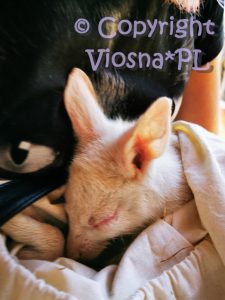
- Joey
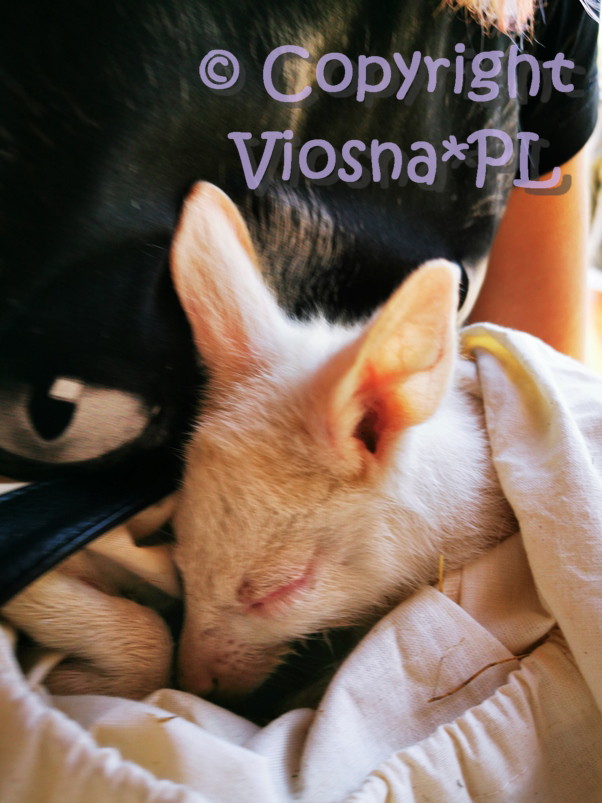
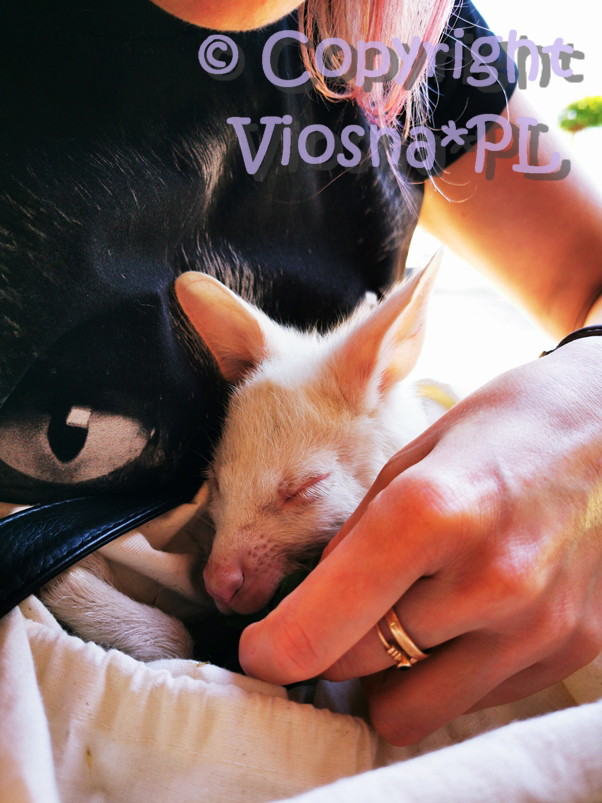
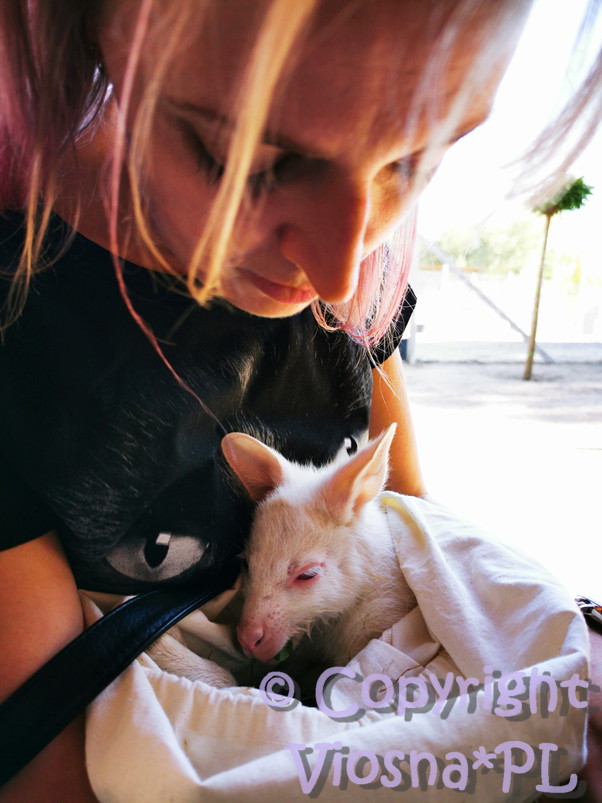
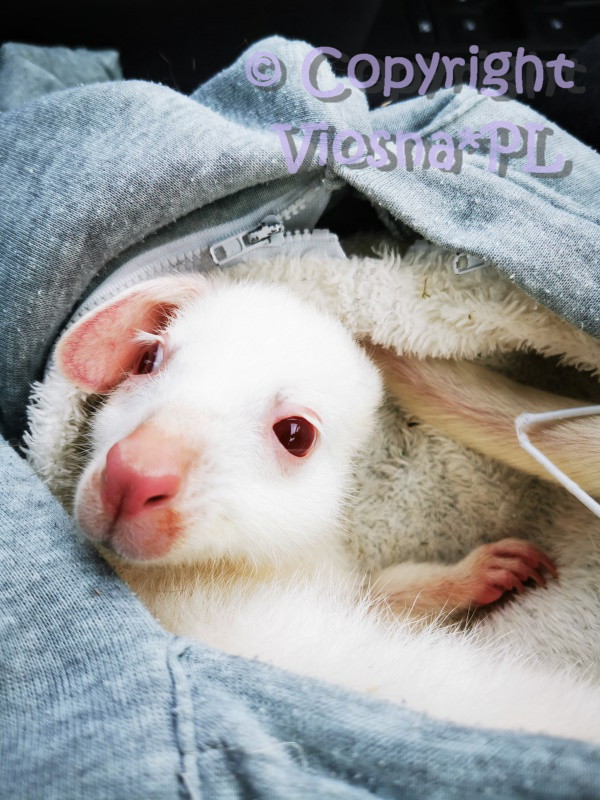
The little one turned out to be a boy and we named him Joey. While searching the internet for information, I found out that in Australia they call most of these toddlers this way.
-
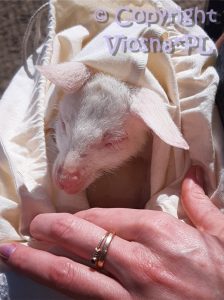
- Joey
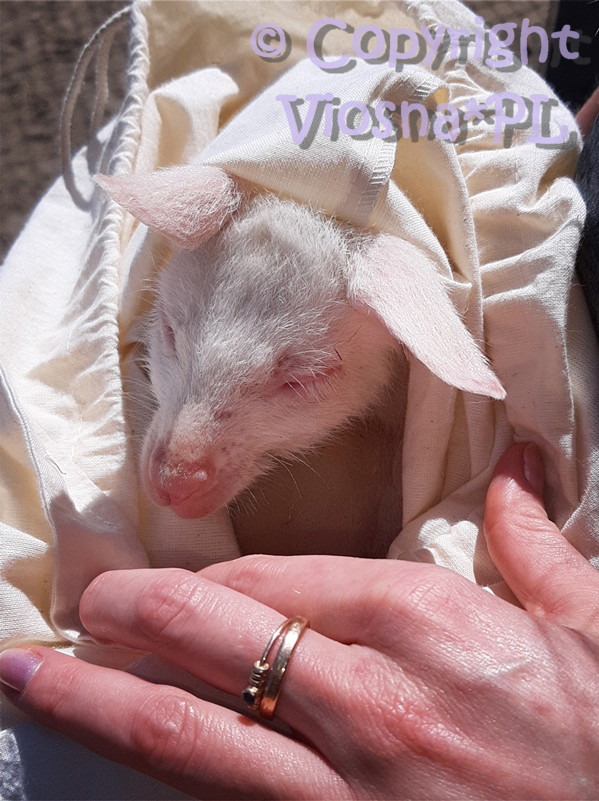
-
- Joey
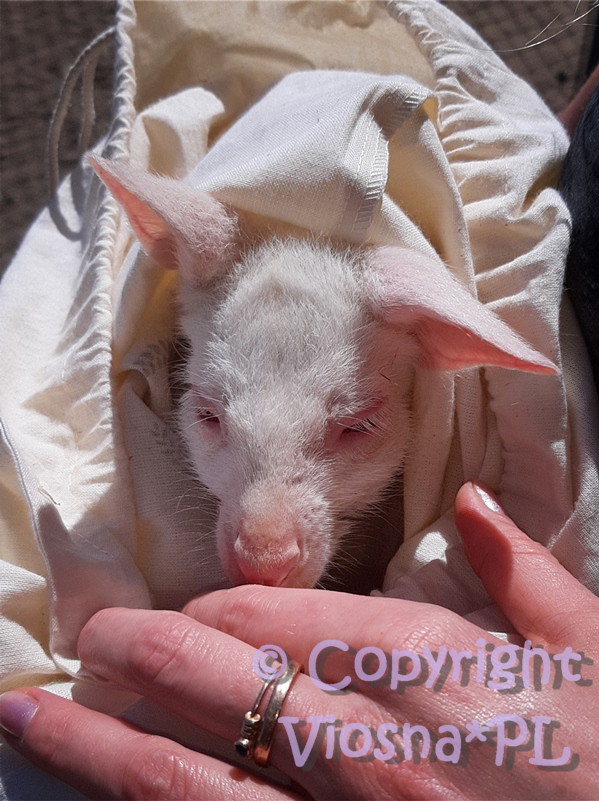
-
- Joey
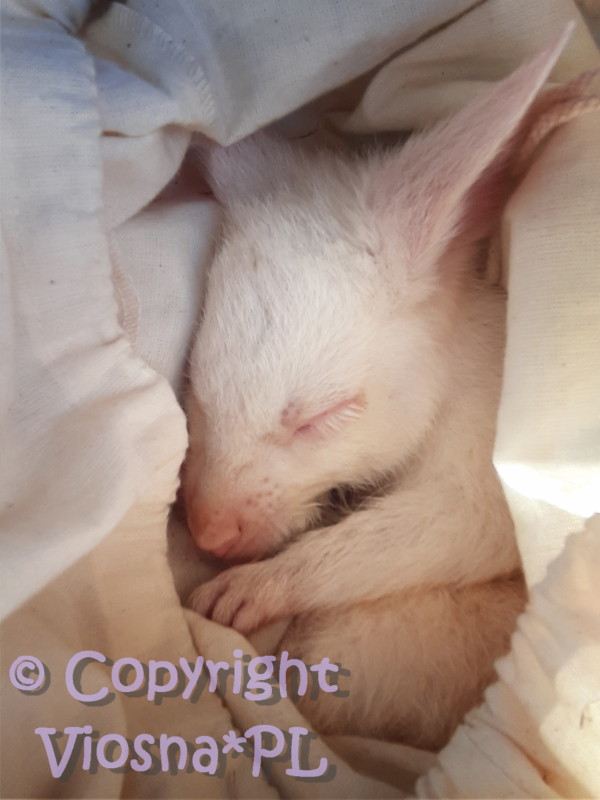
-
- Joey
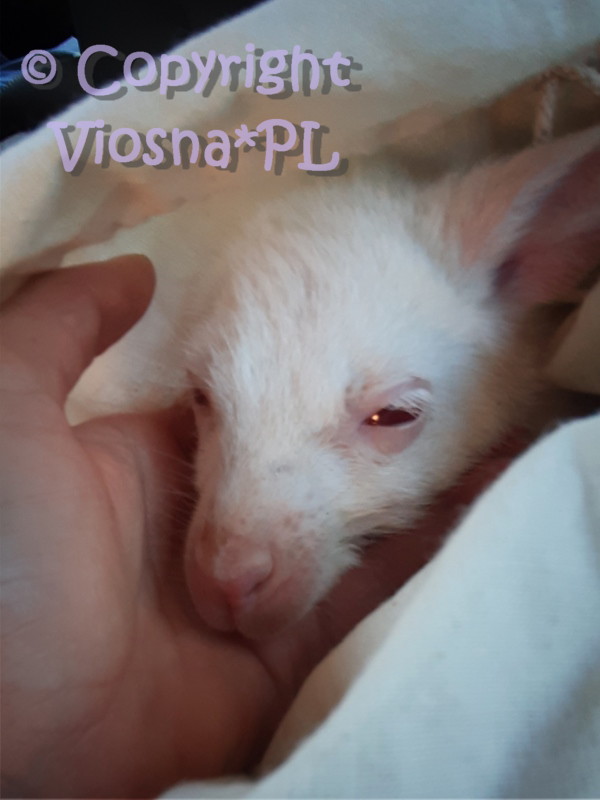
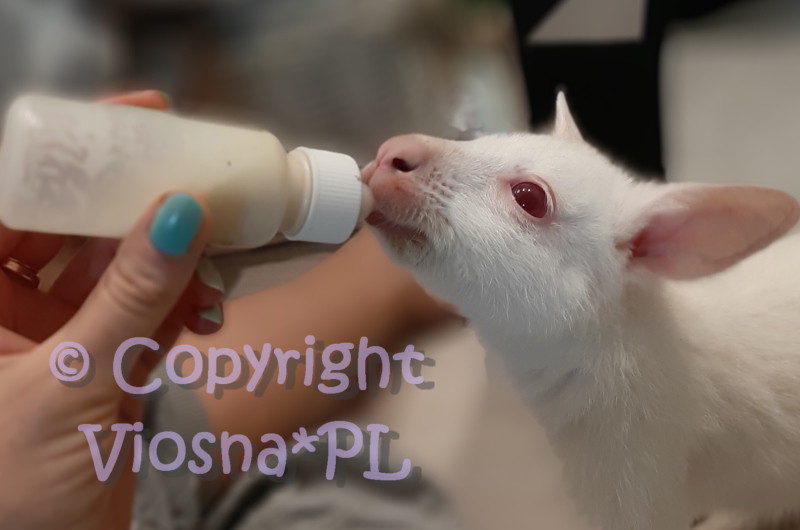
The first challenge was to feed the kangaroo. Although he ate the clover and grass on his own, we did not know how to organize the bottle feeding. The nipples of a kangaroo mom do not resemble those of a queen, bitch, or other typical animals that we know. They are thin, like a tube or a small straw, and about 8-10 cm long. This was problematic because standard feeding sets do not have this type of teat. And frankly speaking, even though we have been breeding cats for 10 years, we didn’t have a single bottle or a teat at home. We made a makeshift set of a drip tube and a syringe, which worked for a while, but significantly limited the amount of milk administered. And it was hard for the little one to suck on the syringe. Thanks to the courtesy of a another cattery from the neighboring (thanks to Mrs Karolina), we managed to borrow a basic kit for feeding the kittens. Even one of the soothers suited Joey a little, and for a few days we were able to feed him. It was leaking a bit, we had to take breaks to let him swallow calmly, but at least we got him on milk.
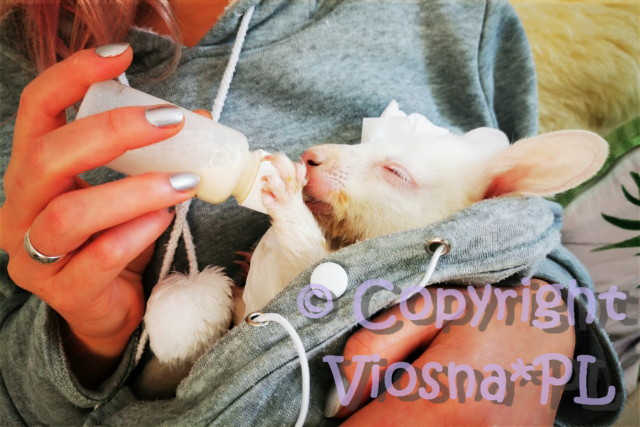
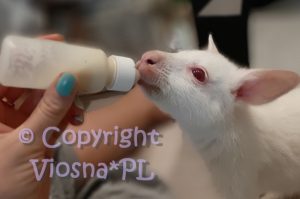
Unfortunately, the bottle nipples turned out to be attractive also for our kittens, who chewed two out of 3 that Joey used. They’ve broke it during the first week so we had to seek for alternative. On the advice of my colleague from work (thanks Marta 🙂 ) I started looking for sets with a nipple for puppies with a cleft palate. It turned out to be a perfect choice and after a little modification by Tomek, we had the suitable feeding bottle for Joey. By the way, cats were hardly interested in it. (As Joey grows, we also managed to switch it recently to a “larger” bottle model with a new nipple.)
-
- Joey
-
- Joey
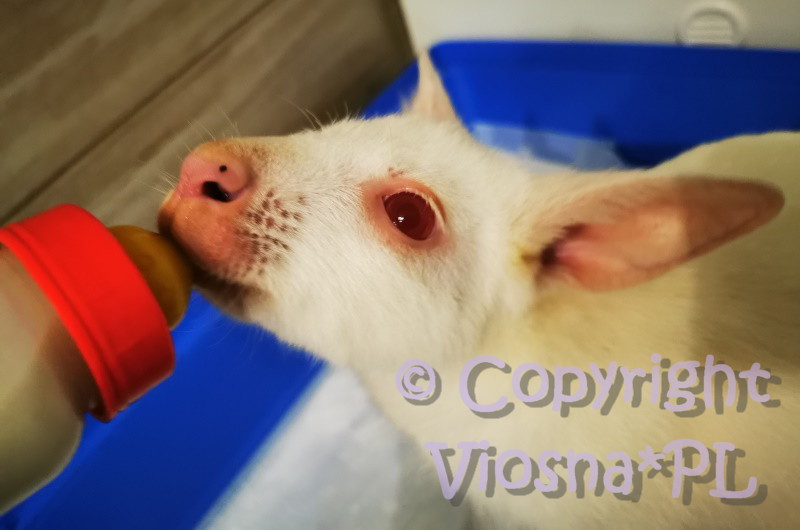
Thanks to the guides I’ve found, we were also able to estimate the average amount of milk per day and for a single feeding. The little one gets a bottle five times a day. Besides that, he is fed with dried lucerne, carrots, sometimes he gets fresh greens;)
From Kraina Dolnej Wisły, we got a human milk replacer without lactose (kangaroos are lactose intolerant from the very beginning). Unfortunately, from what we’ve seen, Joey didn’t like it that much. If it wasn’t for the pandemic and Australia’s lockdown from the rest of the world, we would probably try to order milk replacer for kangaroos to Poland. As here you can easily get formulas for rearing kittens or puppies, there you can buy substitute milk for wallabies and kangaroos on a daily basis. Unfortunately, the pandemic has taken this option away from us. As a result of my internet research, we figured we could try giving Joey a replacement milk for puppies or Convalescence Royal Canin. One of my friends, Dr. Izabela Piórkowska, who works with the Zoo in Łódź, adviced the second option for feeding the baby. And it was definitely more tasty for him.
Joey very quickly adapted himself at our house and became friends with cats.
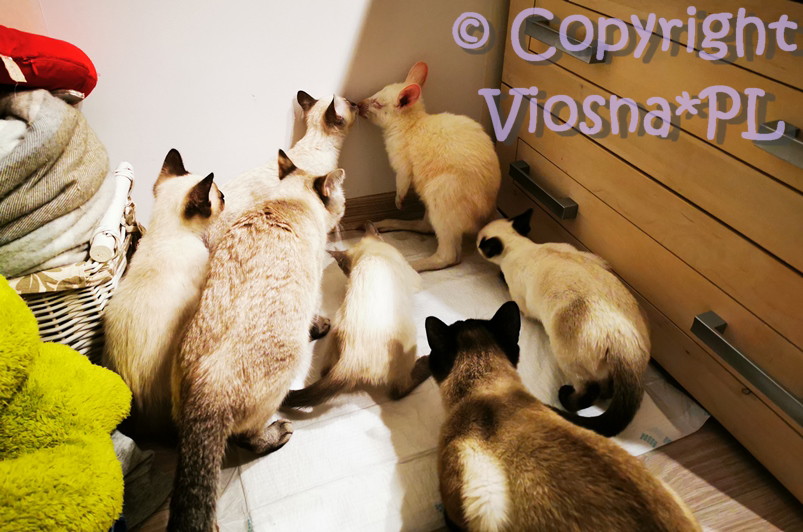
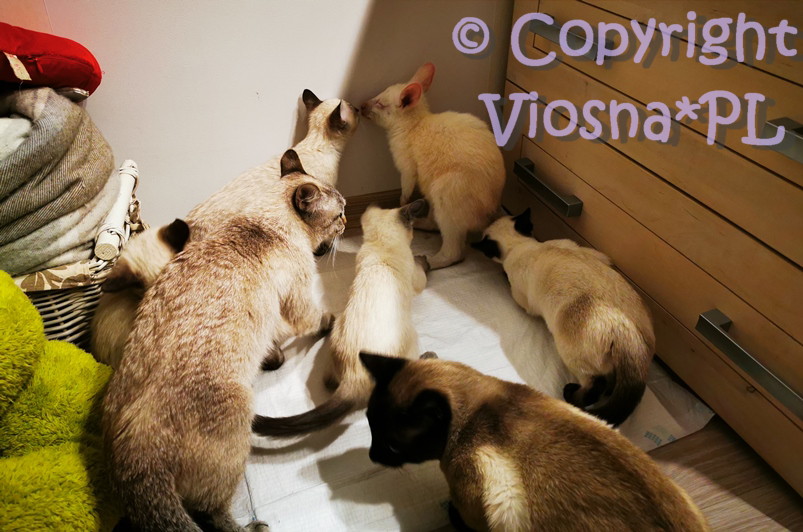
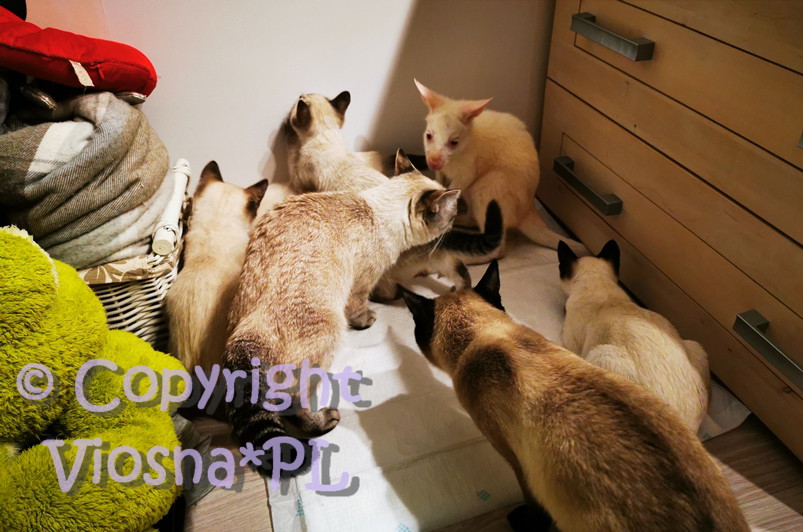
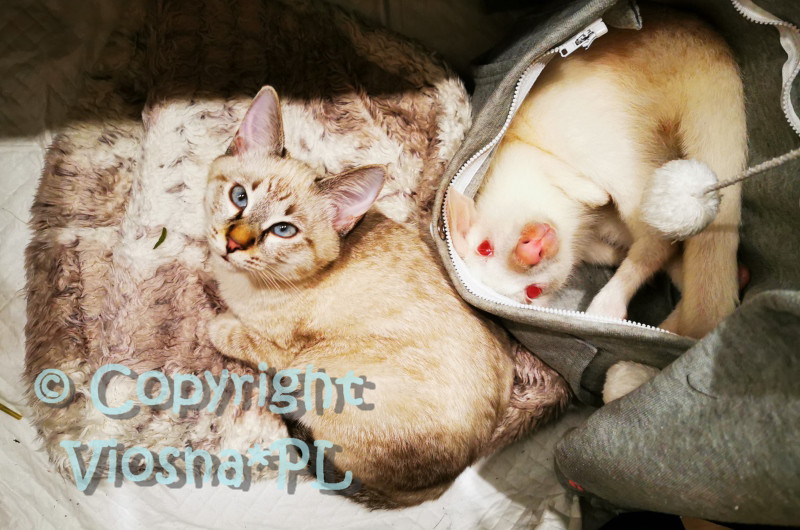
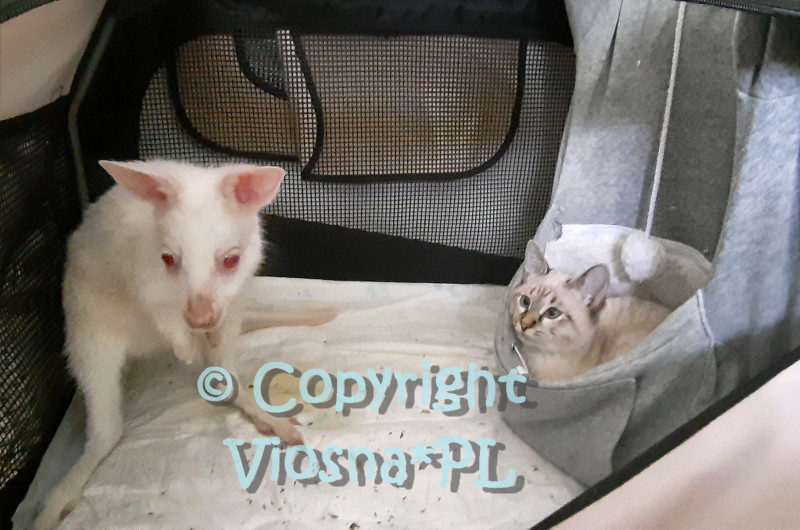
Zosia showed him the greatest interest. She even later constatly got into his pouch in my sweatshirt when he was out.
-
- Zosia i Joey

-
- Zosia & Joey
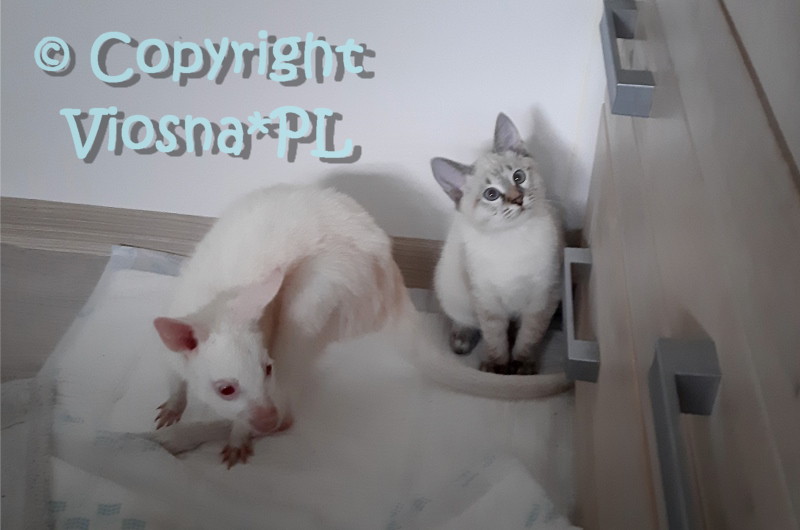
The kangaroo initially moved on all four legs and only a few times we managed to catch it jumping on hinds. Maybe the tiles on the floor did not suit him … But he was good at the cat litter box and even understood what it was for 🙂 He also knew how to use the pouch right away.
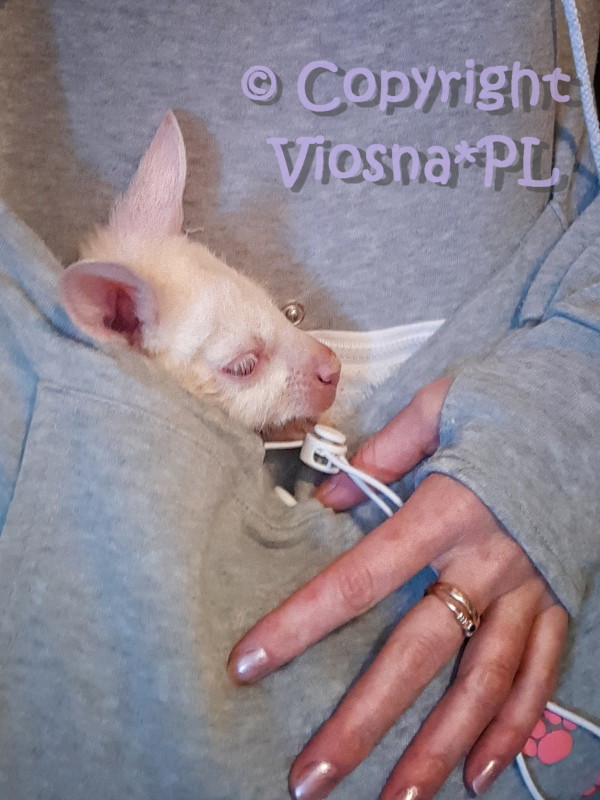
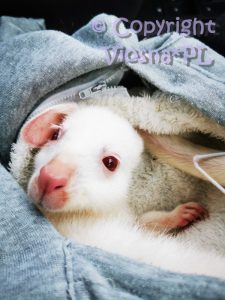
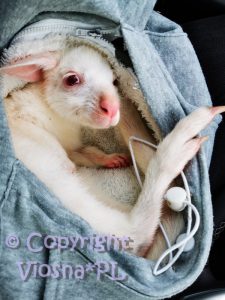
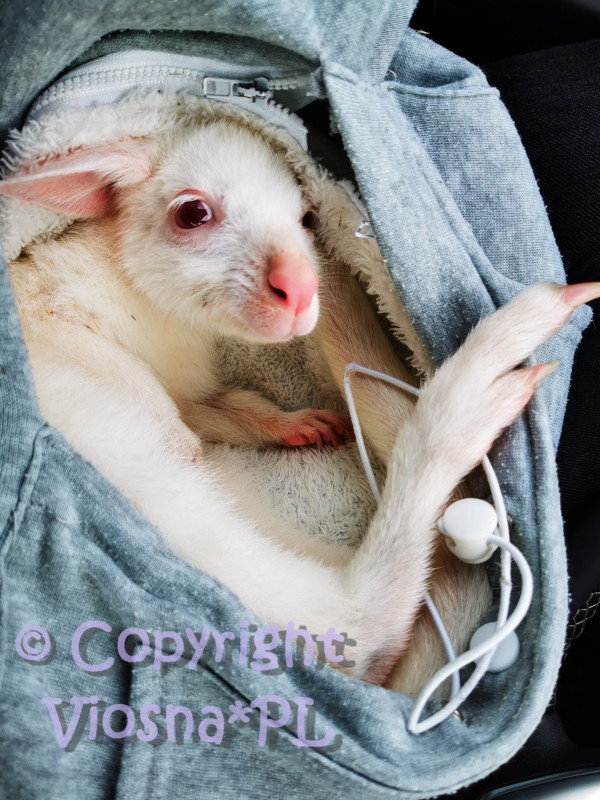
Joey instantly learned to jump into a pocket in my cat sweatshirt and sleep in it. During the first few days, we also took him to bed in a cat’s sleeping bag to keep him warm. With time, he got used to it and even traveled later in a sweatshirt or bag.
-
- Joey
-
- Joey
-
- Joey
On the third day of his stay with us, Joey developed diarrhea. It happened after my return from work from the afternoon shift, which ends at 10:00 p.m. . At first we thought it was a one-time incident, but when the next poo was loose as well, we started to worry. I dare to say that I know at least a little about cats, but from a medical point of view, not very much about kangaroos. That’s why I spent the next hours searching the internet for a possible cause. I dug my way far to Australia, where I found several books on diseases and problems in kangaroos and wallabies. The symptoms matched three conditions, two of which were parasitic – coccidiosis and strongylosis. In the middle of the night, Tomek was going to the clinic to get the medicines for Joey. Before Joey got the injections, we also collected feces for parasite testing and bacteriological culture. The next day, the samples went for tests – the first to Łódź, to Dr. Dawid Jańczak, who is a parasitologist, and the second to the laboratory for bacteriology.
After receiving the medication, Joey had improved a bit and had a good night’s sleep until morning. He had spent the night in our bed and we watched over him for the entire night. His appetite was sometimes smaller, sometimes bigger, but he ate. By noon he was behaving normally and his poo was also better.
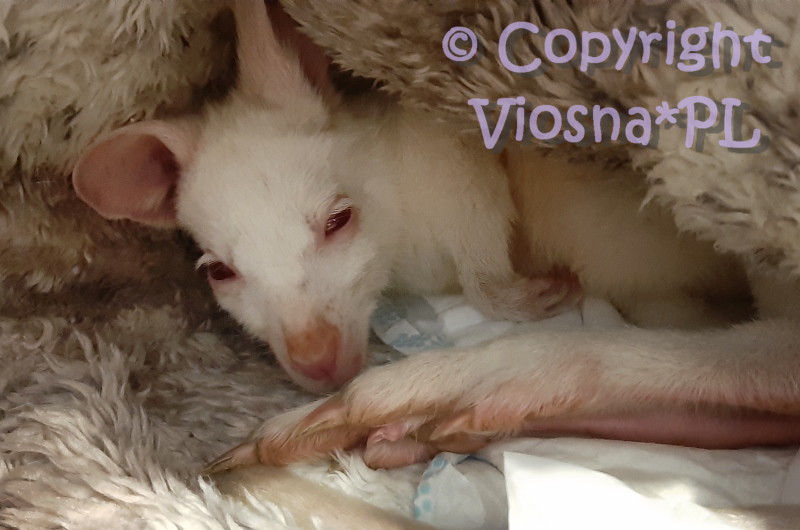
Unfortunately, around 1:00 p.m., just as I was about to get ready for work, Joey felt worse again. He was weak, his stomach ached and he had diarrhea again. He looked like he couldn’t stand nor sit. Plus, his breathing was heavier too. Despite its size, Joey is still a baby, so any diseases can pose a greater threat to him than to adult animals. In the books, that I found earlier, was an information that, for example, coccidiosis (which we suspected) could even lead to the death of a kangaroo. I couldn’t leave the little one alone, even though I should have already be gone for work. Tomek came home early from work and we went with the little boy to the clinic. Time was crucial here.
At the clinic we took an X-ray right away to check lungs and abdomen. X-ray showed a huge bloat (even though Joey with every meal had received drops to prevent that). The gas in his gastric tract put pressure on the diaphragm, which caused respiratory problems. After administering the drugs, Joey ended up in an oxygen tent in a pouch sweatshirt, where he had spent another hour. I had to see patients at the time, but I kept an eye on him all the time. The oxygen tent was set on an extra table in the examine room. Fortunately, the clinic team and the patients didn’t mind him there. Some where surprised that there was a kangaroo but everyone wished Joey a speedy recovery.
Unfortunately, despite constant supervision, medicines and oxygen, Joey still felt unwell. His urine was darker in color, and he hadn’t pooped since entering the clinic. It was to soon to get the results of feaces tests I ordered. I decided to consult my friend who has an exotic pets clinic in Bydgoszcz – doctor Paula Dziubińska-Bartylak. I had to stay at work as I had patients scheduled until the end of my shift. Fortunately, the kangaroo has improved enough to be taken on a visit. Tomek was racing across Bydgoszcz again, this time wearing the little one in a pouch. I was hoping that at the Sowa Egzotica clinic they would be able to examine Joey in more detailed way, as mainly deal with atypical species of animals and have the appropriate equipment for it.
At Sowa Egzotica, Joey had an ultrasound, which showed bladder trauma, abnormal peristalsis, and slight ascites. There was nothing while with us, to cause such a problem. We suspected that something might have happened to him when his mother passed away. It is possible that there was an injury or he got crushed by her at that time. Joey’s blood was taken for further testing, he got an i.v. fluids and medications. Also some fresh faecal sample was needed for test at the spot, but Joey didn’t really feel like providing any. Finally, Tomek said to give Joey a litter box with wooden litter (we use corn litter at home, but they didn’t have that). It turned out to be a great idea, because they got a feacal sample right away. Unfortunately, when examined under a microscope, it turned out that there were trichomes in the stool. I was told that there is a risk that he might not make it.
Such a diagnosis terrified me as some species of trichomonas can also be charmful in cats. After a sleepless night, stress and frustration with joey’s problems, this information struck me down. The rest of the shift and the rest of the evening I spent blaming myself that not only I didn’t know if Joey would make it, but I might have also put our cats at risk. Although at first I assumed that herbivorous kangaroo and carnivorous cats couldn’t have the same gastrointestinal conditions. Fortunately, the next day, Dr. Jańczak from Łódź contacted me about the results of Joey’s parasitological test. He reassured me that my assumptions, that kangaroos and cats had separate parasites were correct. The trichomonas species found in Joey did not pose a threat to Elma, Whisper, Hela, Codzik, Dziabąg and the kittens. But there was also a bad news, that he found coccidia in the sample (but also harmless to cats). Therefore, additional drugs for this type of parasite have been added to Joey’s medicines.
In summary, Joey’s health problems associated with the injury (such as bladder hematoma and ascites) and all that stress (related to mom’s death, moving to a new home, and changing nutrition) – alltogether contributed to a decreased immunity. This was joined by disturbances in the gastrointestinal flora, which created favorable conditions for parasites he must have had before (but controlled by his immune system). Trichomoniasis causes diarrhea and colitis, and coccidiosis can result in disturbed intestinal motility, which favours bloats and can lead to atony.
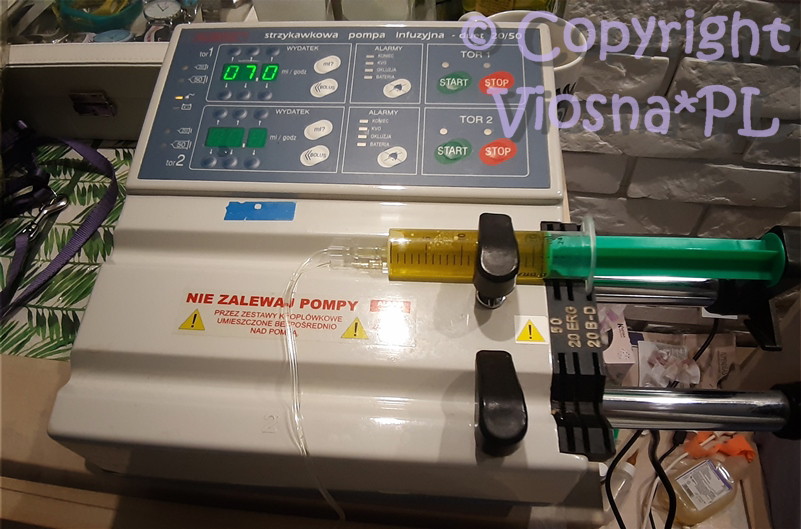
At home, Joey received medications several times a day. Among other things: something to support peristalsis, espumisan to prevent flatulence, 2 types of antibiotic, probiotic and fluids. With his size, we had to be careful about the amount and rate of fluids in order not to cause additional problems. The drip was connected to an infusion pump borrowed from the clinic. We adjusted everything so that the infuser would not interfere while he’s eating and sleeping in the pouch. From time to time it was necessary to attach a new syringe with liquid. Fortunately, Tomek and I took turns at home, so the little one was looked after all the time – day and night.
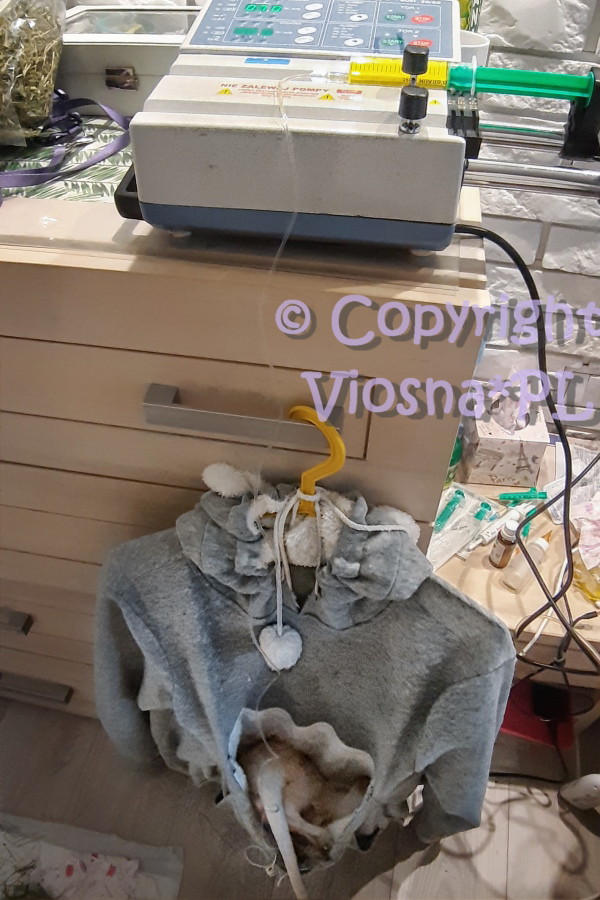
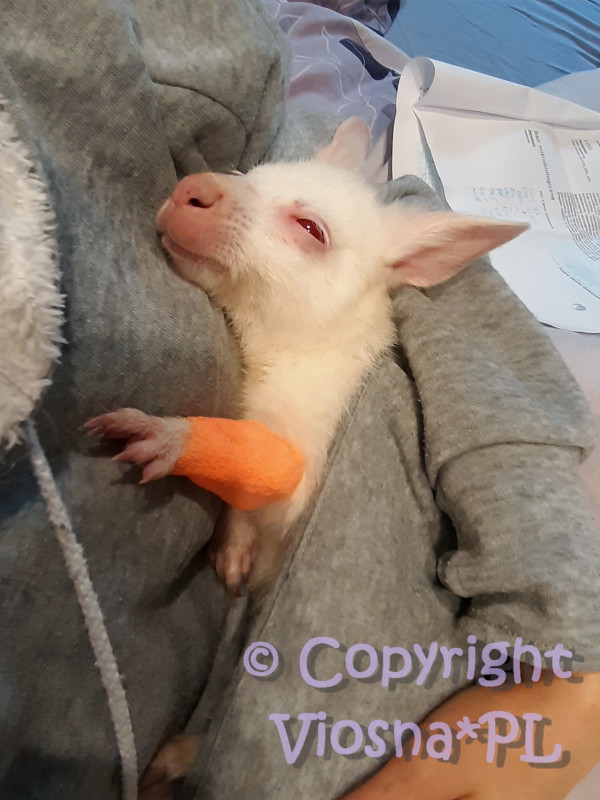
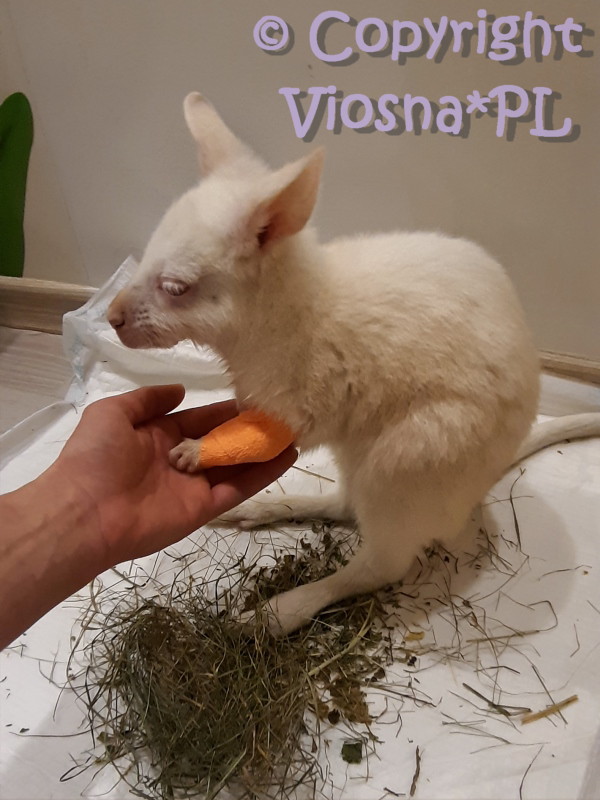
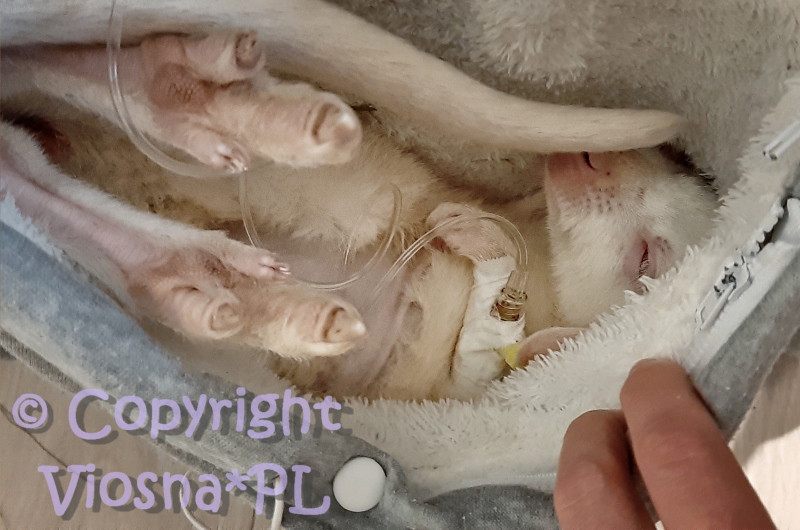
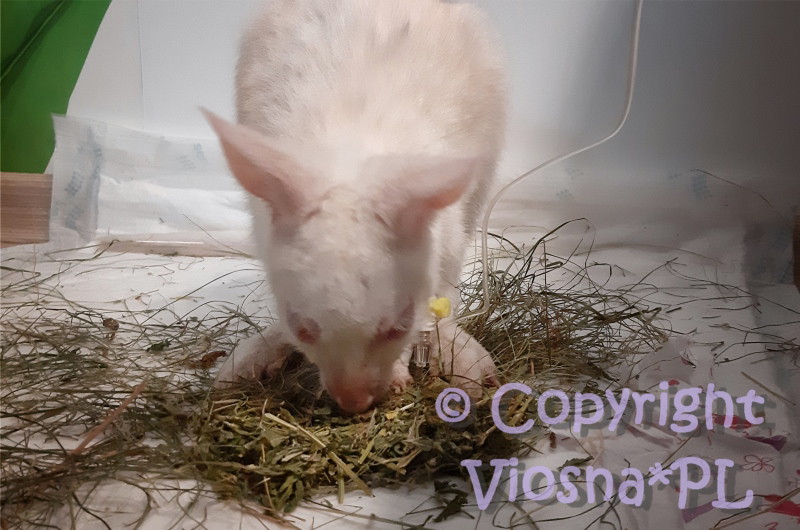
Thanks to the drips and drugs, the urine began to return to its normal color. Poop very slowly, but also was getting back to normal consistency. On follow-up ultrasound, the amount of fluid in the abdominal cavity decreased a bit. Peristalsis was also a little better. Joey did fart while feeding, but somehow it didn’t bother us. We were glad that he was getting better – his appetite was returning, he was more fond of milk and even started to eat dried lucerne on his own.
However, we were not yet able to rest. Joey fell ill on Tuesday, got to the clinic on Wednesday, but he was recovering for a dozen or so days. On Friday, Zosia, who became best friends with the kangaroo and spent most time with it, got a fever. We knew Joey couldn’t get her with any parasites. We assumed that maybe the whole stressful situation had lowered her immunity, and some viral infection was about to start. After the anti-inflammatory / antipyretic syrup, probiotic and immune-boosting capsules she felt much better. But not for long. On Saturday, Tomek had to come with her to the clinic during my shift. Despite the medications, the fever returned and Sophia felt very bad. On the way to the clinic, she got a diarrhea and vomited her breakfast. With little ones, regardless the species – kangaroo or cat – the problem should not be underestimated. Something that can be asymptomatic or mild in an adult animal, can be a serious threat in young animals. Zosia was given a drip with vitamins to help lower her fever, supportive medicines and antibiotics. As I also assumed it could be pancreatitis, she was given painkillers as well. She was a very polite and brave little patient. Before I let Tomek take her home, she has improved a lot. She wasn’t so depressed anymore, she was interested in her surroundings and even started purring.
On Sunday evening, Sophia had an episode of worsening, despite the medications she was given at home. Despite the rain, Tomek went to the clinic for an additional antibiotic, which turned out to be the solution. Sophia felt much better, started to play and her appetite returned. From then on, she began to recover without any further problems.
But that still wasn’t the end of our worries. On Monday morning Elma developed diarrhea. Apart from that she didn’t seem to feel any different than normal. Since I had an early shift then, I took Elmirka to work to give her some fluids and administer her medications. Knowing what helped Zosia, Elma got the same. My mother picked her up later so that she would not have to spend the whole day in the clinic until the end of my shift.
Also on Monday, we got the kangaroo stool culture results. The lab found no highly pathogenic bacteria, only pathological overgrowth of Escherichia Coli, which is also a normal gut bacteria in cats. Nevertheless, all animals were given a prophylactic probiotic and antibiotics selected according to the results from the laboratory. In the end, the kittens would had to stay with us longer and we had to reorganise the schedule of vaccinations and spays. However, sometimes it happens in catteries. Not everything can be planned all the way and there might be some complications as these are live animals. And in this situation, our priority was the well beeing of the kittens and the certainty that they would go to their new homes healthy.
Fortunately, the steps we took and treatments proved to be sufficient. No other cat got sick, and Elma and Zosia quickly recovered. Joey was also getting better every day, his appetite was getting bigger and he was starting to put on weight. When he came to us, he weighed less than 1.5 kg, and in the middle of the treatment he was 1.8 kg after 10 days.

Zosia & Joey
Joey grew stronger every day, he got used to us and became attached to both us and the cats. He did not even mind taking naps together, when the kittens were invading his booth or when Zosia took up his pouch in his sweatshirt.
-
- Zosia & Joey

-
- Zosia & Joey
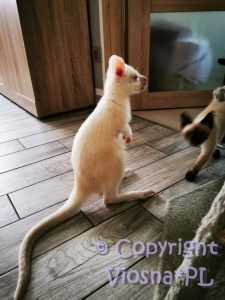
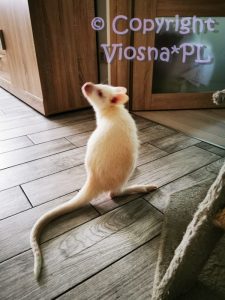
In time, he felt at home more freely, he would walk in the corridors and rooms. He perfectly understood the layout of the rooms and knew how to return to his kennel and pouch on his own.
-
- Joey

-
- Joey
-
- Joey
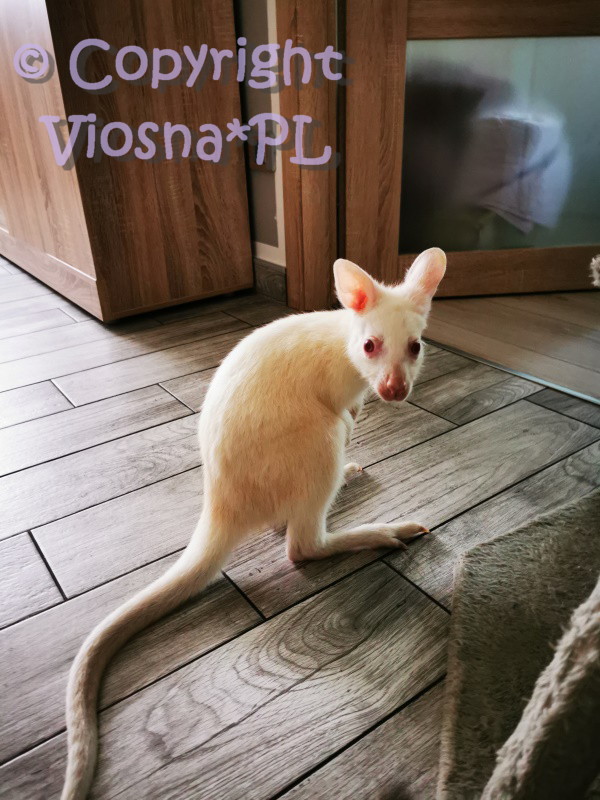
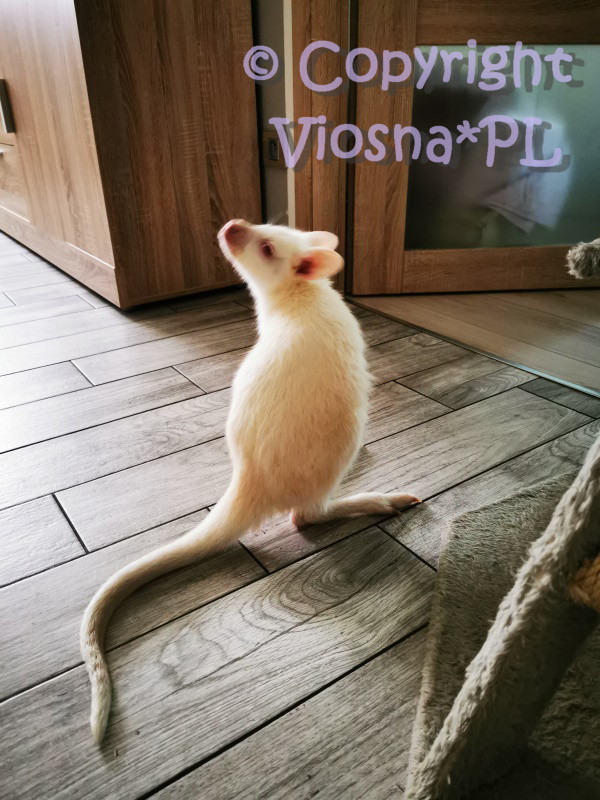
Joey originally had a booth and a pouch in our bedroom, but he needed more space over time. Lately he was given one of the cat’s rooms. We moved him along with his playpen and a pouch, and over time we hung another, larger one (currently Joey weighs about 4 kg). When we are at home, he has access to the entire apartment so he can jump everywhere he pleases. When the weather is nice, we also take him to the garden. At first, he would go for a walk in a cat’s harness, but once he started to know the place better, we let him loose. If he wants to go home, he goes to the door himself and waits for us to open it. It is similar the other way – if he wants to go outside, he stands at the door to the garden and waits, or sometimes even tries to jump on the door handle, like a cat.
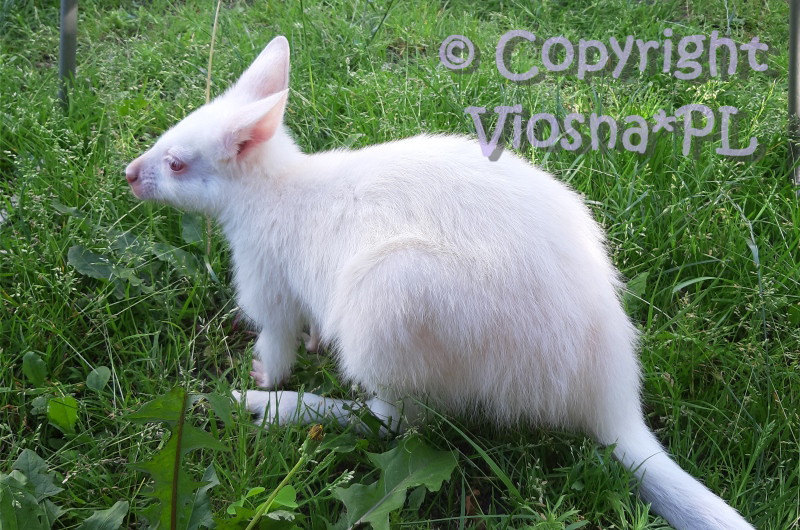
When it is wet or it is raining outside, he cannot go out so he doesn’t eat wet grass. It can cause serious digestive disorders and bloat.
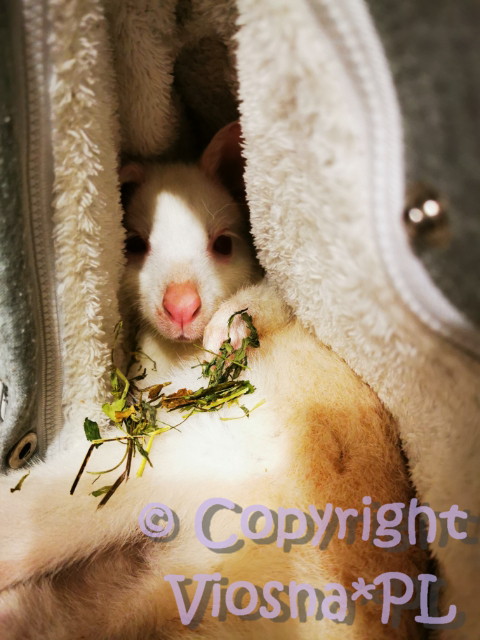
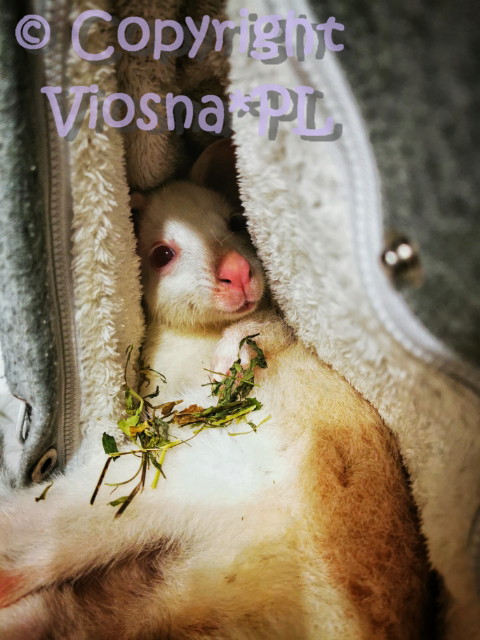
Over time, Joey learned to talk to us and “chats”, but mostly at feeding times, whenever he hears the bottle. He gets milk several times a day and depending on the work schedule, Tomek and I take turns during the day. These days the kangaroo can come to the kitchen and rush us on, if the meal time is delayed. His diet initially consisted mainly of milk and dried lucerne.
-
- Joey
-
- Joey
-
- Joey
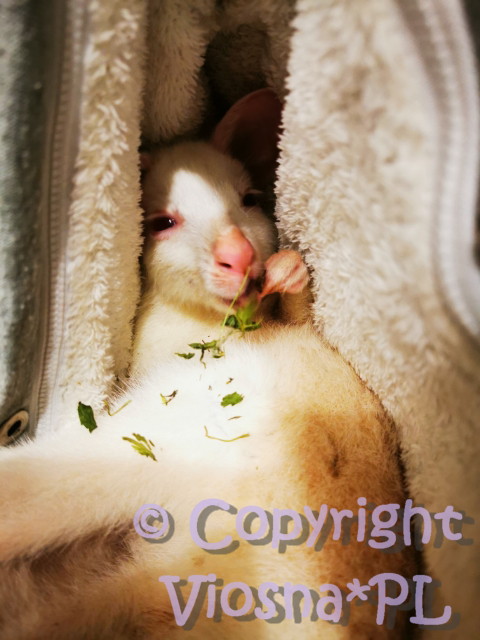
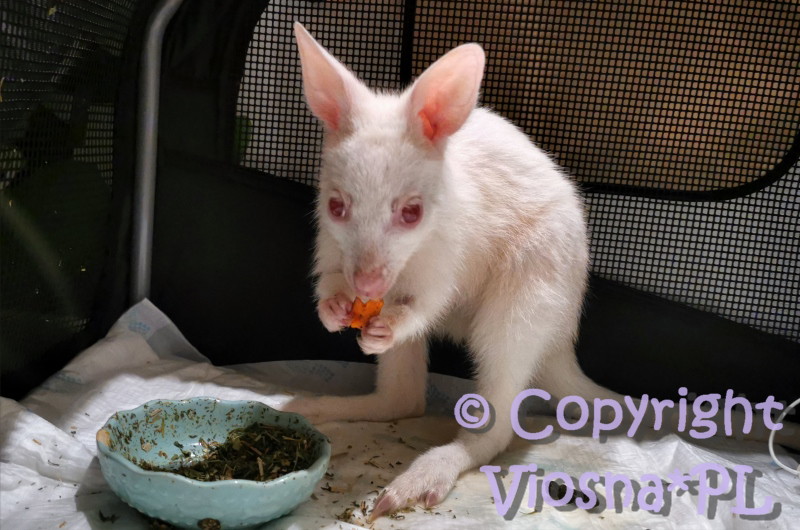
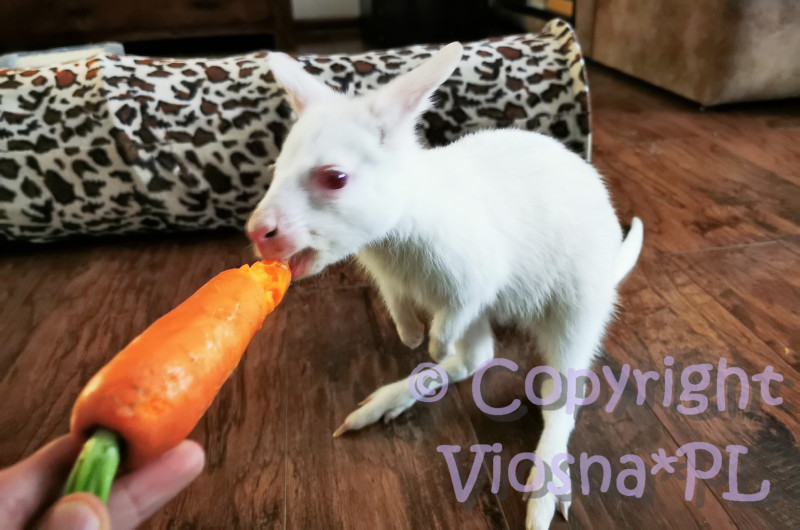
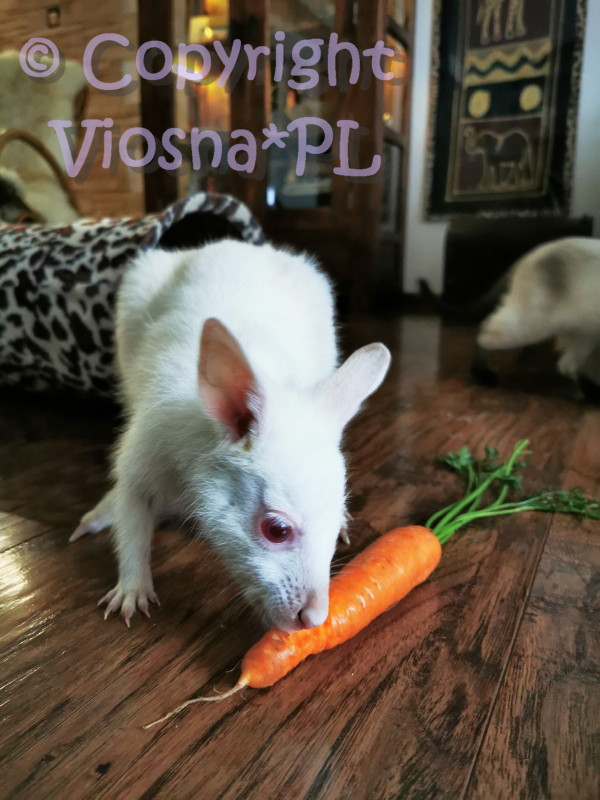
Over time, we expanded his menu with hay, dried clover, some dried flowers and leaves (e.g. of strawberries, echinacea). He also gets fresh carrots, sweet potatoes, mint, apple and pears.
-
- Joey
-

- Joey
-
- Joey
-
- Joey
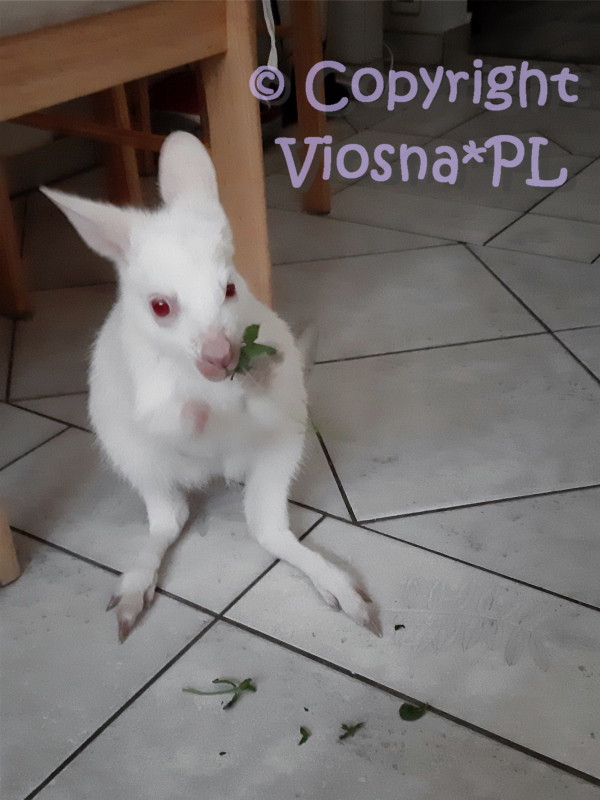
As for the toilet, the kangaroo initially learned what the cat litter box was for. Unfortunately, with time, he started to eat corn litter from it, so we had to take it away from him. We noticed that he often pees and poops while eating. We bought a 120x60cm cage bottom, and put hygienic pads in it, with a bowl with dried food in one corner and hay in the other. He quickly learned how to use it. As a result, we have managed to limit the situations when he urinates around the house. Now the biggest problem is that he tries to eat my books in the living room.
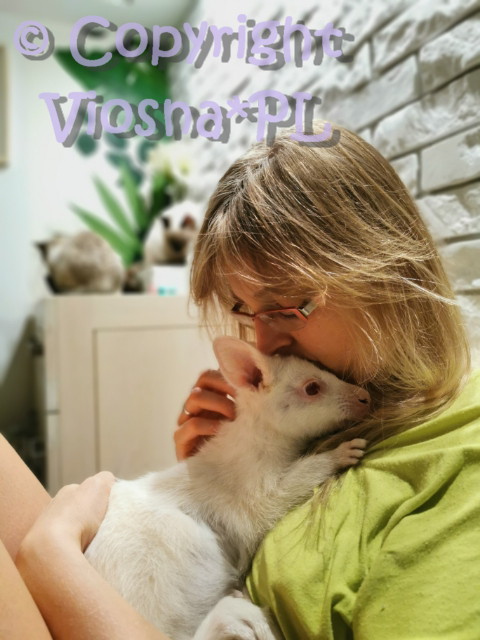
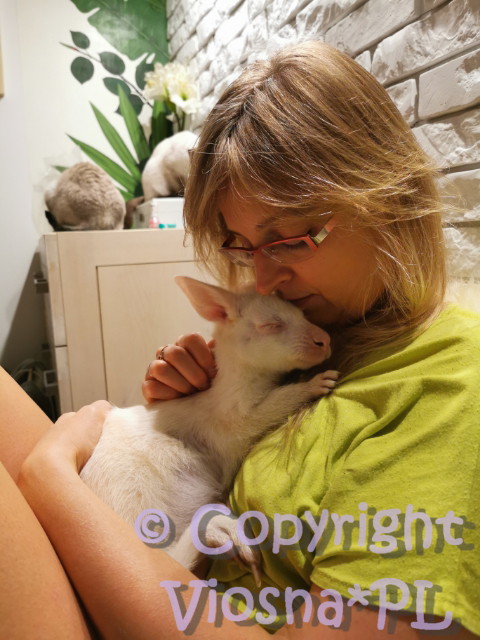
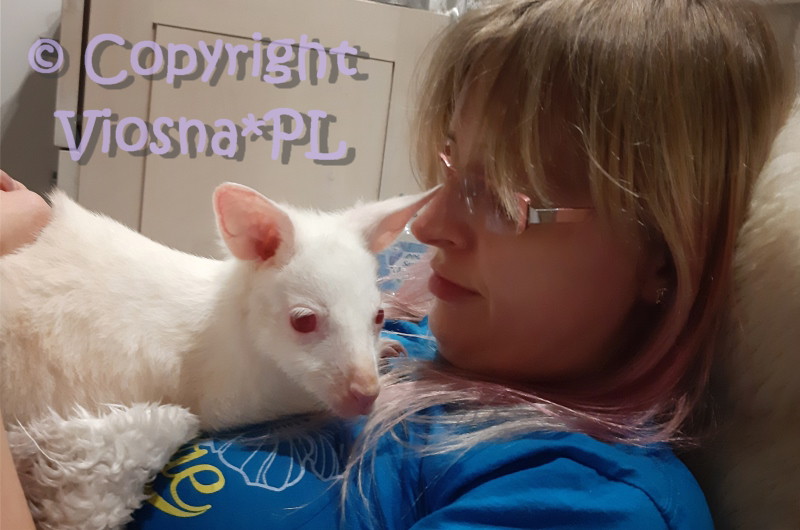
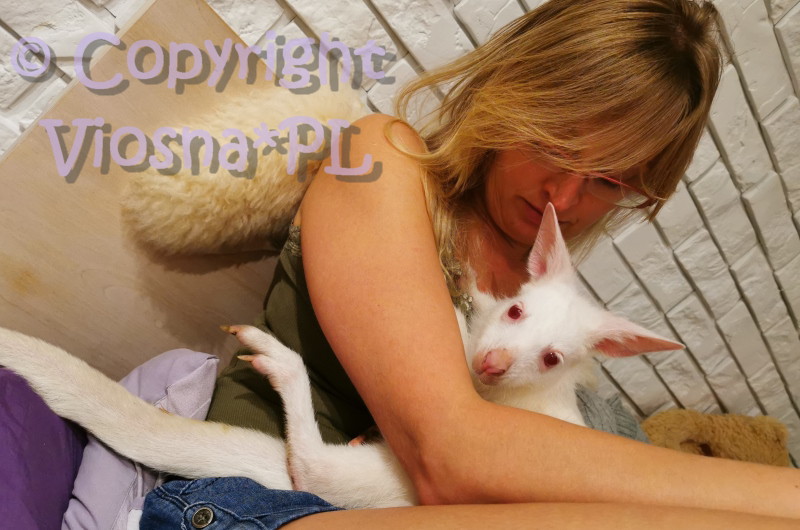
Joey is shy with strangers and is not quite as brave as our cats. But still, as for a wild animal he is very tamed. Well he doesn’t come to be pet , carried or huged. But when I manage to pick him up and cuddle, sometimes he can sit like that for over an hour.
-
- Joey
-
- Joey

-
- Joey
-
- Joey
-
- Joey
-
- Joey
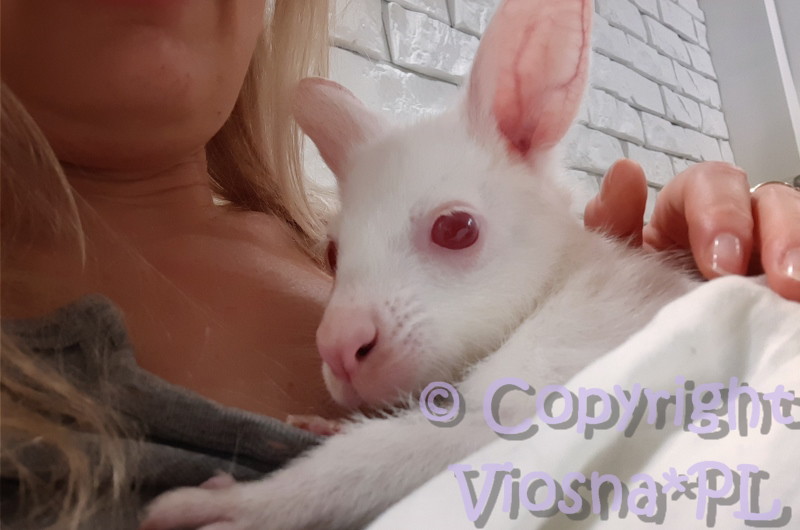
He even puts his head to be pet. It happens that we can take a nap together in bed and the kangaroo sleeps hugged. It happens that cats are dissatisfied because of this, because they have to lie down somewhere else or on a side, and not under the covers. However, we did not observe any tensions or quarrels because of this.
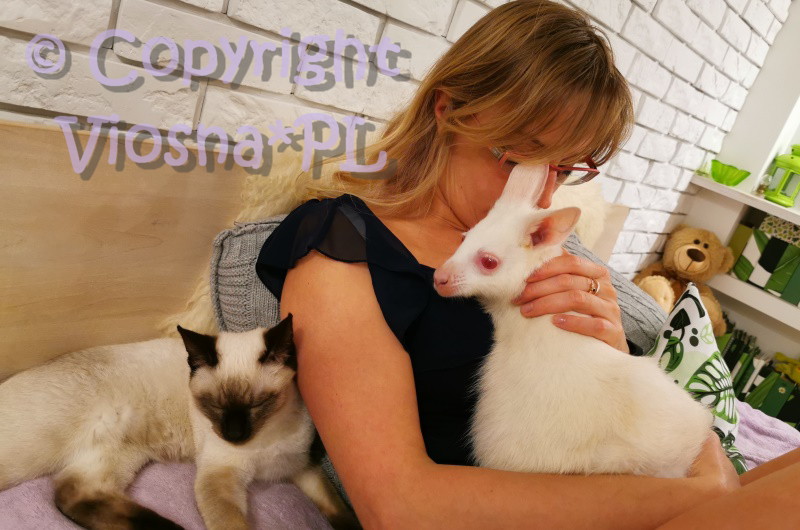
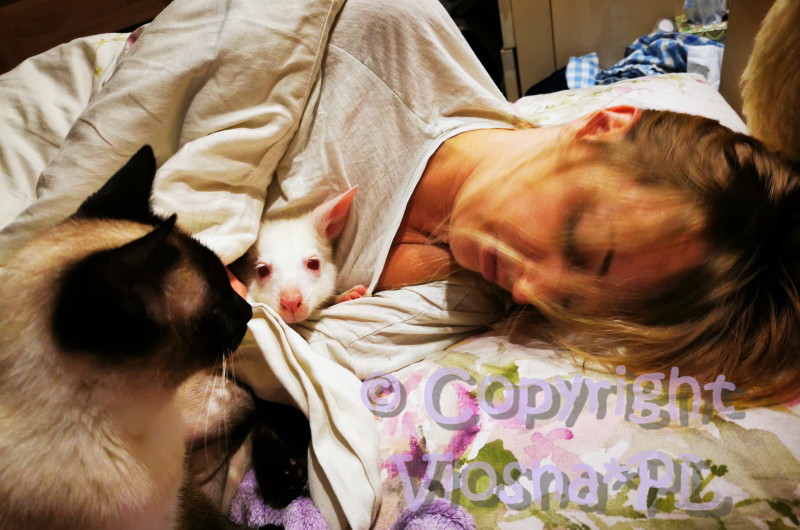
Our gang just got used to the kangaroo and they treat it like another cat.

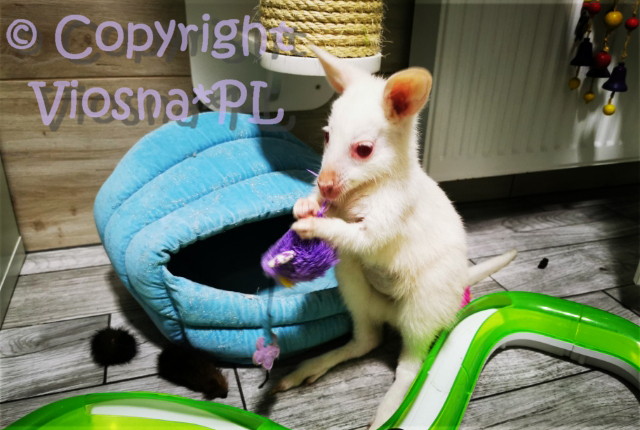
Joey even tried to play with cat toys, but he wasn’t very good at this. Well he doesn’t know how to play together like a cat, but Joey and the gang get along without any problems.
Red-necked kangaroos spend 9 months in their mothers pouch. On average they start to come out of it and eat grass at about 5 months of age but then they get back in it. They drink milk from their mother up to 12 months of age. And that’s at least the time Joey will spend with us. We cannot give it back earlier due to the stress that it entails. In addition, moving to another home before the milking period is over may create a greater risk for him. He was accepted into the family by us and the cats, so we are responsible for him. Even if he’s not enterily ours (legally he belongs to Kraina Dolnej Wisły).
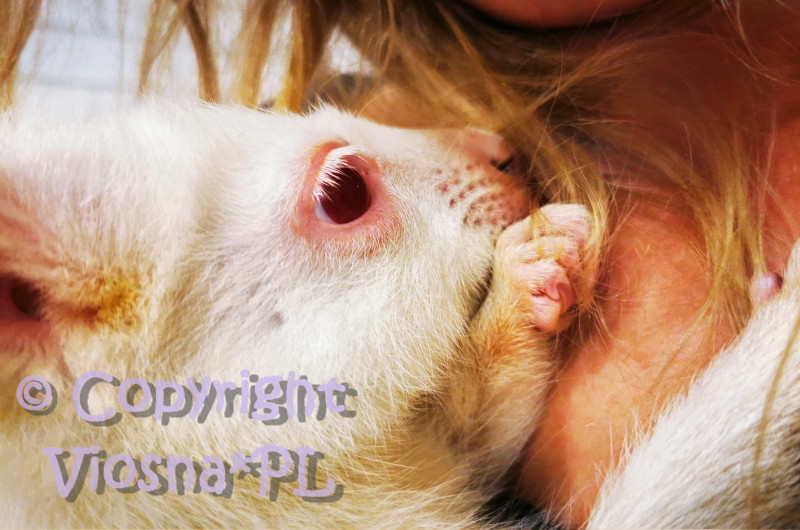
Joey
We fought for him at the very beginning when he got seriously sick after stressful change of homes and “switch” from his mother’s milk to a milk replacer. We don’t want to risk the situation repeating itself. For us it is associated with additional obligations, costs and less free time, but since we have already taken it for rearing, we want to do it properly. So far we don’t know what will happen to him later. Red-necked kangaroos can live up to 15 years. Adult males ca weight up to 18 kilograms.

