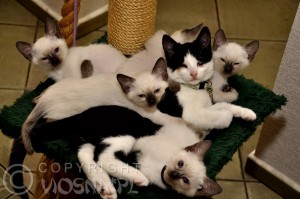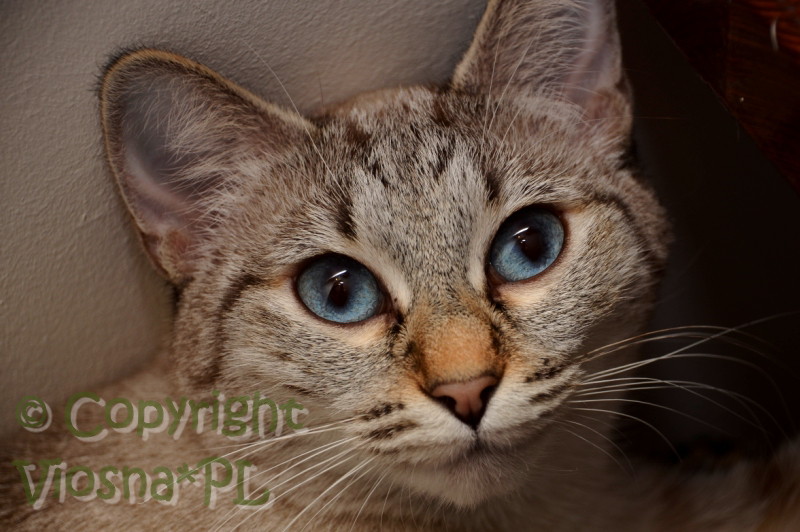
 Thai breed (called also old style siamiese or classic siamiese because of it’s descent) was approved in 1990. Cats from that group have dark points in so called cold body parts (face, ears, paws & legs, tail) and magnificent blue eyes. In difference of current siamese cats, thai cats have more proportional body and round head, face profile has a little break in the eye level. Their temper is also a bit different. Thai cats are gentle and kind, very dedicated to their family and loving their people more than anything.
CHARACTER
Thai cats are a unique breed not only because their beautifull, blue eyes but also thanks to their unusual character. They are more like a dog companion rather than cat individualist. Huge affection the cat has for his owner, can be seen both in cats look and behaviour.
Thai can be a companion in all house duties, not beeing intrusive and not disturbing the owner. Properly taught – perfectly understands what is allowed and what isn’t. Because this breed is very calm and balanced, sometimes all they need is just someone presence, possibility to watch and say something on their own. These animals develop a great affection for owners, enough to feel the mood and take care how people feel. (Often when I have lost track of time working late, Whisper would jump on the desk and lay down on my documents – letting me know it was time to sleep.) You can say that for thai cat – the owner is the etnire world and cat would go through fire and water for him/her. This can be very usefull especially during holidays cuz it makes travelling a lot easier 😉
Because thai cats are very intelligent they easily learn new tricks (opening the door, drinking tab water, clicker training etc.). They also understand what thay can and what are not suppose to do. (Whisper very quickly learned what “get down”, “no”, “stay” mean). Consequence and owners commitment are crucial on the begging of setting those rules. But when it comes to thai cats, it’s not that hard. Thanks to all that it is posibble to avoid most of the trouble and “destruction” caused by cats of other breeds.
Thai cats are a perfect play companion both for children and adults who can provide an interesting amusement. For example with a piece of ribbon, lace or rattling mouse. Not minding the age of a cat – desire to play remains, making it a great play-friend for cats entire life. Another advantage of thai cats is their remarkable attitude towards children. They show great patience and care and some are even very protective.
Thai cats are not agressive and very easy make friends with people and other animals. Sometimes they may need a little more time. Those cats easily adapt to owners lifestyle and time table. When owner is gone cat would simply go to sleep awaiting his/her return. (When we leave for a bit longer, Whisper always sits by the window looking out longingly.) But thai cats love company so they shouldn’t be left alone for too lng. Luckily their character gives opportunity for having more pets around the house.
APPEARANCE
Thai cats are shorthair breed and according to standards they should have:
- wedge shaped and gently rounded head, strong and rounded lower jaw and chin
- profile slightly curver with a little break on the eye level
- medium ears, turned just a little to the middle, slightly rounded tips
- blue eyes, widly set, upper lid almond shaped, lower lid rounded
- strong and short neck
- sliky and soft coat, shorthai, no undercoat, very easy to take care for. Thai cats insignificatly shed.
Thai kittens are born completely white and get their colors over time.
There are many different point colors.
- Seal point – black & dark brown color of points
- Blue point – blue colour of points
- Lilac point – lilac colour of points
- Chocolate point – chocolate brown colour of points
- Red point – red colour of points
All of the above can also come in tabby – the points be striped in certain colour (ex. seal tabby point, red tabby point).

HISTORY OF THAI CATS
Refernces about far east breed from Kingdom of Siam appeared around XVI century. These were cats living in the tamples, where purity of the breed was guarded. It was believed these cats had supernatural powers. At first the only owners ould be members of the royal family. Probably that’s why cats of that breed reached Europe at late XIX century.
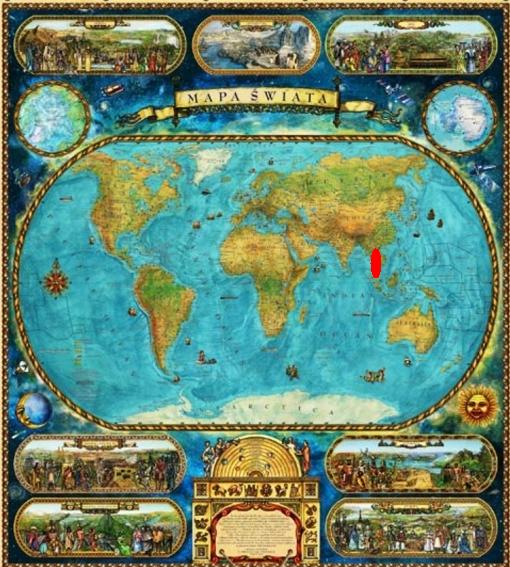
First cats brought to Europe were great attraction because of their unique colours and beautifull eyes and were shown in zoos. First cats bred in Europe were shown in 1871 in Great Britain. Huge interest in that breed started rapid development of thai breeding. In 1892 first breed standard was established (it was changed many times later on). Thai cats were mixed with other breeds and their unique attitudes (blue eyes, points, balanced attitude) – that used to be reserved only for cats from Siam – helped develop new breeds and new colours.
In middle 50’s of XXth century siamiese cats sill looked like todays thai. But because of many generations of selective breeding classical siamiese became more slim and slender, have more norrow scull, longer face, proportionally bigger ears. As a result siamese today look like on the photo below.
SIAMIESE CAT

THAI CAT

As you can see the differences are easy to notice in comparison to orginal siamise cats living in the area if Thailand. Around year 1980, breeder from North America and Europe decided to help to preserve the o riginal classic line of cats coming from the Kingdom of Siam and keep their unique attitude and apearance.
Considering different type of present siamiese cat and a narrow gene pool for breeding in west, new cats were imported for breeding directly from Thailand. Unfortunately because of formal issues with their origin (pedigree) most of the felinology assosiations didn’t recognize them. It was decided to set this type of cat as a new breed that can be evaluated with other standards than those applying for modern siamise cat. Because of significal differences in apearance it seemed to be the best solution. Thanks to that, in the 90′ the new breed and it’s standards were established. And as The Kingdom of Siam became Thailand – new breed (which was actually the original one) was called thai cats.
At first one of world organisations for cats breeders, called Fédération Internationale Féline’s (FIFe), didn’t recognise the new breed, but many others, like World Cat Federation, The International Cat Assosiation recognised and accepted thai cats. On the beginning of 2014 an official request was send to FIFe and it was positively considered also by this organisation. In 2017 FIFe fully recognised thai breed.